clues at the scene

clues at the scene
Showing posts with label real crime. Show all posts

Wednesday, October 11, 2017

Harvey, Harvey, Harvey

At left, the mess that is my desktop.

I have a bill from the state for car tags because my state does it on one's birthday.

I've a trade magazine from the fly fishing industry to get through (No, I'm not "really" in the industry. My dollars are.) I've flies to tie - design in the background of the transcription palette. 

Also, I have to pass basic seamanship again. Yea. Again. Like, thirty-odd years on. I don't have the certification I need for the boat I want to lease and so insurance demands documentation.. That's the flag for India which means I am turning to port absent any other signal.

This has been an ugly week in the entertainment industry. I'm going to let the events lie where they may and take a literary approach: the fallen hero.

Studio mogul. Bum. It took what, forty-eight hours? Maybe seventy-two.

I've got some things I need to happen in the current work in progress. It occurred to me a fallen hero, a mogul, a fellow of influence, wealth, and accomplishment might be the exact sort of supplemental character I need to make some improbable events transpire.

I have a copy of Joseph Campbell's Hero with a Thousand Faces stuck on the arm of my reading chair right now.

The fall. The fall.

The devil is a most attractive character. Nobody gives a shit about the saints.

Off to the ink.

Tuesday, March 10, 2015

Loaded Subject

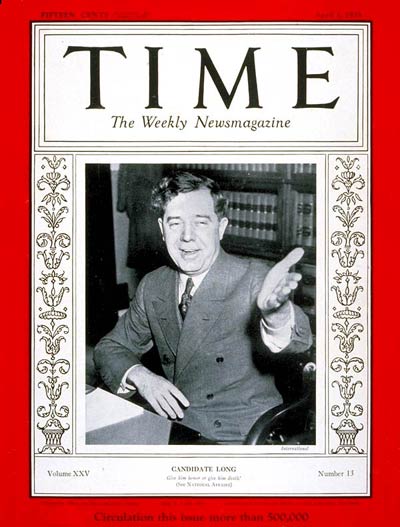
Image of Huey Long from Time magazine for which they failed to renew the copyright. Public domain, now.

Thanks.

Huey Long.

You know about Huey?

"Share the Wealth" - a wealth redistribution system based on an asset tax. Of course, more than 60% of the population of the state lived below the poverty line and most had to walk a whole week just to get to it.

He created a proscription list of enemies in the public employ, fired them, and demanded that those allies he hired contribute a portion of their cash earnings to his re-election fund.

That was just the warm-up.

Here he is on the cover of Time.

Now, picking on political corruption in Louisiana is the social science equivalent of laughing at a disabled kid on the playground. It wasn't like he asked for extra personal challenge and picking on him is just mean.

However, taking a little bit of what we know about Louisiana politics and spreading it around?  It helps make a story interesting.

Corruption is interesting.

As she said: I like the bad boys.

Who gives a shit about an Eagle Scout who wins the county spelling bee.

Now, rig the contest. Ahhh.... we've got something.

So, just when you long for honest politicians as devoted public servants walking the straight and narrow, be grateful for the pile of horse droppings we've got.

There are two things in this world that'll do you wrong every time: an unloaded revolver and a smiling politician.

Don't keep either hanging about.

Unless you are writing crime, that is.

Wednesday, March 19, 2014

The Big Empty

This is a grain elevator from just outside the big empty. Where I grew up, this was the mark of industry. This, and shabby oil derricks.

On the map where you see no roads, no towns important enough for any but the smallest dots, that's the place: the big empty.

There's a story I heard when I was a kid that in one of these little bergs, two men were found dead on a gravel side street beside their car. No one happened to live anymore on the little block where they lay.

They stayed that way for three days until a sheriff's deputy happened by and had them collected.

It wasn't a serious matter for the law. They were from somewhere else. Order is taken more serious than law in some places.

You haul your own load, carry your own secrets, wave at the neighbor you haven't seen for three months. Everyone wears of a mask with more than a little distrust.

It's the sort of place where little changes in fortune made a big difference in the community. Someone got a new car - and I mean new car. Someone's kid went to college back east. Someone bought a new horse worth a cutting of hay.

For every up there's a down and when someone went up, the neighbors all watched waiting for the inevitable reversal of fortune.

I think of it as a balanced environment where all things were conserved locally: nothing untoward happened without offset. Secrets couldn't be kept long.

As writers, we like the other side of that eventuality. We like ups without offsets. We like downs without redemption. It's easier for the reader to put our stories in a large context if we tell part and let the reader fill in the rest.

Tolstoy tells you everything. You know it all from beginning to end.

Hemingway tells us little. We know sometimes the end. Sometimes we know a middle.

I increasingly like stories where we know the early elements of discord and change, their initial event chains, and we know the sharpest of the transformations. The rest?

I'm not in the happily ever after business. 

Neither are you. Tell us enough that we see the consequences of conflict and transformation. 

You don't have to put a bow on everything.

In crime, don't show me the trial, merely point to the criminal. In literary fiction, you don't have to make him chase after her in the final scene loading everything he owns in an old Chevrolet to drive to Salt Lake City.

Leave a couple of bodies on the ground. Let's see in our own mind if anyone notices.

I'm going to write and see if anyone notices. I think you should try the same. Maybe you can find a big empty in your house in which to do it. Maybe you've been a bit of a big empty on the map thus far, too.

Let's make that dot grow a little, shall we?

Thursday, August 29, 2013

Hippos in Tanks

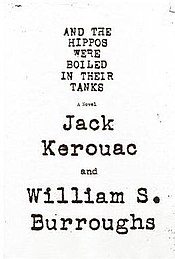
At left, the iconic novel by the beats: Kerouac and Burroughs.

Ultimately, the book is about a murder.

I oddly like killing off characters. I put them in the book and then boom - they're dead.

Now, in my youth I killed characters of little utility. In fact, their principal role was fodder for the grinder. I killed without passion. I killed without concern. I just killed them as a matter of happenstance.

Lately, I've been killing characters of potential depth. We might want to know more of them. Sometimes, they're the most likable character in the story and I put them down like so many extra puppies (thanks, Homer for The Iliad).

I believe that my evolution in the unfortunate demise of otherwise meaningful and perfectly good characters is out of a respect for their absence. I want the reader to feel the shortness of breath knowing the mortality of someone they might have wanted to know. I want the reader to feel.

Right now. I feel the wet muzzle of a foxhound.  I need to pet the dog and write.

I know you're writing. I hope you're remembering to pet the dog. At least, let him out.

Release the hounds, I say.

Tuesday, July 23, 2013

Cleaning Up

At left, tools of the trade.

Under the title of profession you may not know about is that of the appliance man.

Oh, this isn't the guy who fixes your washer. These are fellows who are ace disposal agents for the bodies and evidence of an unfortunate demise.

My first introduction to them was some years ago when I learned that - if available - a refrigerator is  the ideal storage compartment for the freshly dead. Yes, it is a beast to get the body inside. However, the problems of fitting nicely do not require the work of dislocating the hips as a dishwasher does.

It's nice to believe you can stuff a body in a mattress. They aren't made that way anymore. You can carve one up but it takes more than just a pocket knife and a leatherman tool.

Removing the evidence gets harder and harder. You cannot spray bleach around and believe the smell will go unnoticed.

The true crime section is full of "almost got away" stories with the tales of how, with a little more care, it might have worked. If you're looking for "foolproof" then these books have much to offer. It isn't my cup of tea. I write fiction. I make shit up.

Need to cover up blood stains? I give a character an industrial marine-grade spray epoxy.  Meh. It works. It isn't like I have to go and buy the stuff then live through its application.

Cleaning up is however an important topic in mayhem. Bodies are huge bags of liquids. They get all squishy. Getting rid of one is like moving 200 lbs of wet pasta. I love when a murder occurs in a book, the body is moved, and the detectives find not a trace. Oh, that makes me so happy. (Sarcasm - learn to recognize it).

How do I solve it in my stories? I have the killer leave the things as they fall. I don't want to have a conversation about how a Prius won't hold a man of 6'3" unless he's dismembered. I've hot-cut meat. I don't want to go there.

I hope things are tidy in your neck of the woods. I hope you're letting the bodies lie where they fall.

If not, watch your back. Throw it out moving Jimbo to the dumpster and you'll have a hard time getting into the convertible with the dame.

Tuesday, July 16, 2013

Head Over Heels


A little football got a little rough in Brazil.

The article is here: soccer-referee-decapitated.

The fans decapitated the referee and put his head on a stake in the middle of the field. That is, after his body was quartered.

Now, bodies are hard to pull apart and even with a panga, they are tougher to split than your average grocery store chicken. It makes the story suspect to me. 

Nevertheless, it is common enough to read about the headless corpse in the crime genre. I'm not a fan. I prefer my corpses with heads. 

Dismembering a body might make it easier to transport but the end game is a bit like making paper cut-out dolls with you daughter: there is an awfully lot of material spread about which creates a very large mess for a very little bit of fun.

Oh - you say. It makes identifying the body harder to do.

Unless you're freezing them and traveling a good distance - say across state lines - most people who go missing as in "dead missing" have someone somewhere calling the cops to report it. If your local union steward takes an unplanned vacation without telling the wife, you can bet the homicide boys are going to be johnny-on-the-spot when limbs start appearing in garbage cans behind the local eateries. They'll figure right out who it is they're finding over a large metropolitan area.

Oh sure, killing a transient and moving their parts about: sure. You got me. However, we're civilized murderers here. We kill for reason and purpose - and personal amusement at the screams of a victim aren't a good purpose for crime. Horror ? Sure. Sicko-lit? Of course. Not however in my crime, please.

Miles Archer gets it and we wonder why ...till we meet Iva.

I'll say I prefer my corpses intact with small calibre bullet holes ruining the front of their best suit. It makes the game more interesting to me. It's easily understood by the reader and there is no need for ballistic information that seems to dirty so much otherwise delightful writing.

Who cares that the body was blown out of the floor from the Barnes-X in 165 grain 30-06? If it isn't falling thirteen stories and killing the shyster lawyer whose implied blackmail was brushed off by the recently deceased, what does it matter?

Shoot 'em. Put 'em down.

Don't make trophies. It isn't sporting. It's beneath you.

The Edgar? There's a sporting trophy for you.

I hope you're writing. I hope you're watching your football in the comfort of your living room without the threat of decapitation.  

No stoning, please.


Monday, June 10, 2013

Farm Country Bad

Swedish farm country can be rough. There are cows to milk, eggs to gather, hay to pitch, and brutal murder to solve.

Henning Mankell created the Wallander character (featured on PBS by Kenneth Branagh) as a near alcoholic detective dragging so much self-loathing and regret around as to require a safari train of porters to help.

I liked this first book in the series for the issues of Displaced Persons in Sweden and the brutality of the countryside murder. Right in the front of the book Mankell hits us. Sweden. Summerfest, blonde girls. Oh, and murder.

Wallander as a character becomes tiresome after a bit. Self-doubt and loathing only get you so far and the brightest star in this guy's heaven shines a little dim. I feel I need more variance in the characters I read for pleasure. All Wallander is missing is circular bruises on his temple in the morning from pressing his service automatic against the skin too hard.

I'm starting a new series of stories myself tonight. I outlined one at Bear River and have figured out how several things I've worked on will fit together for this series of stories. I don't think there is a novel among them; but, it could be a collection when I am farther along. It is a good drill and I'm going to work on these for the next 120 days (with the exception of a story entitled "Wabakimi" which I will stop and polish sometime in July).

Is it inspiration? Probably not. It is a partial solution. A workaround - as it were. It is a Wallender solution. At its best, it isn't bad. That's about where this one is found.

Try a little Swedish mayhem. There is more afoot than Ikea and meatballs. Ohhhh, I do love a good murder in the countryside. Makes me feel like it is old home week.

http://www.grahamhistorical.ruraltel.net/nemecheck/nemechek.html

Wednesday, May 8, 2013

The Language of Transgression

At left, a bust of the man you know as Julius Caesar. This is a bust in the Museum at Naples. It's also my favorite of all. In person, you feel it compelling you to act on orders.

I intended to write an entry every night this week. I've had some network trouble. Apologies.

I am writing now of transgression. I write of the act of harming another. I know this topic well as do you, dear readers.

Tonight, Commentaries on the Gallic Wars. Ick. I hear recoil. I hear retreat.

Listen.

I've read them. I've translated them. I've studied them. I've even lectured upon them. They are magic.

What you learn from Caesar ( and just about any translation you'll buy is good unless you download something free) is that transgression, betrayal, disappointment, misdirection, and physical harm are all first cousins.

Try this version. It has trouble but then so do they all. caesar.

Telling you I will do something and then doing something to act against you is a betrayal. It leaves a scar of hurt mostly because I didn't estimate your depth of deception. I was at fault. You hurt me because I failed. Every time I hear your name, I'll know this hurt.

Acting against you openly and telling you through my emissaries that I intend to go on acting against you and converting others to my cause is an affront. It is a direct style of transgression aimed at you. I am telling others that you are impotent to stop me and I am convincing them to side with me.  You support erodes. You statue diminishes. You self-esteem must suffer.

Waiting until you are content. Letting you believe it is a quiet time, and then harming your allies. Hurting the people you told you'd protect, people who work with you, people who trust you to keep them safe: this indirect attack is perhaps the must cutting. I hurt them to hurt you. Of course, you cannot be everywhere.

But then, let's look at you. There's a problem there. Oh, you say you're just keeping your guard up. You say you're just being on alert. Your actions exclude others. You respond to my attacks by your own and the causalities from your actions look just as bad on the six o'clock.

You march about doing harm telling everyone it's a "defensive action." You have to do it to protect your interests. Naturally - we all agree until the body count is published.

What is most telling and most cold is however your account of your actions. It is dispassionate. You were wronged and so in proportionate force debated in council you responded. More wrongs, more response. We lose track of harm and response eventually. We know however from your prose you did too. We see that harm - transgression - is just a means to you. It becomes a way to ensure a type of stability you control.

You come to love the fight for the privilege it bestows upon you. The transgressions grow and with them a kind of esteem for you are a war lover. You live for the conflict and use it to shape the other events around yourself ... events which otherwise are outside of your grasp.

Now, read some Caesar and tell me the dispassionate narrative about the transgressions does not create a more interesting character doing the telling than any meaningful joy in the tale.

Read widely. Write often. I hope you are writing.

I'll try and write tomorrow and them an update on Monday.

Sunday, March 3, 2013

The Swimming Lesson

The picture at left is of Dexter, MA. It's a mill pond taken by Andrew Rabbit.

I wrote a story yesterday that takes place at a pond. I hadn't intended to write it in its full rough draft. I got started with notes and unexpectedly wrote it to completion. I learned a great deal writing this story. I remembered reading August 1914 by Solzhenitsyn when I was done. I borrowed some cinematic lessons I learned from that book back in 1979.

My story involves a drowning and adolescent boys. It is about contemplative murder though and the pending demise of a swimmer is just the consequence of choices and not the result of physical action.

People forget that cruelty is one of the best formed social aptitudes in the young. This revelation is hardly new in literature but I am satisfied that my construction and presentation is sufficiently distinct. I suspect everyone has one of these stories in them. Maybe more.

The Swedish film Let the Right One In has a fabulous dramatization of these very sentiments as a climax , though with a very unexpected outcome.

In my story I avoid directly drowning one of the youths featured, but you know it is going to happen.

I enjoy more and more the tales where the violence takes place off the page - either before or immediately after the story in question. There is a degree of clinical separation from the violence in this fashion which I find appealing. I do not want describe the precise nature of a killing to my readers. I don't think they're earned that relief.

I believe having the event occur in the readers' minds under their own framework will create a more visceral experience.


I've not read enough King to know if he does this. I read a handful of his short stories in junior high.

It was a very sensible junior high. We'd had out first serial killer and rapist whose trial was in the local paper. The school board had real dangers to worry over. Literature and scary stories were not on the reactionary radar.

Of course, In Cold Blood was required reading in eight grade. We took our murders and rapes early in life. Mockingbird in freshmen lit.

Saturday, August 25, 2012

Weegee, our kind of lense


Weegee would be proud of the snap. Of course, in crime, mystery, suspense and generally all of literature the death is as important as the life. At least, the death gives us all plot elements. Occasionally, we also get images.

[Disclaimer ... blah blah blah real life blah blah blah fiction. Know the difference. My threshold of revulsion is asymptotically infinite. Yours is not. Get over it.]


Permalink  - you want image #5 of this exhibit. The _NYT_ isn't allowing direct links (or, I'm inept).


I haven't see this well a framed crime shot since the mob hits of the 80's.

Weegee ? ->  Weegee

And ... as we are all about books : Getty Exhibit.

Also, there is a good discussion of the image by the media covering the media here.


Credit : Sam Gewirtz  

Also of interest,his piece about the